
The venue is 60 miles out. Your packages were priced for jobs across town. So do you eat the drive, pad the quote and hope they do not flinch, or put a number on it? Most pick a number out of thin air. Here is what thousands of them actually charge, and how to set a travel fee you can defend.
What event pros actually charge for travel
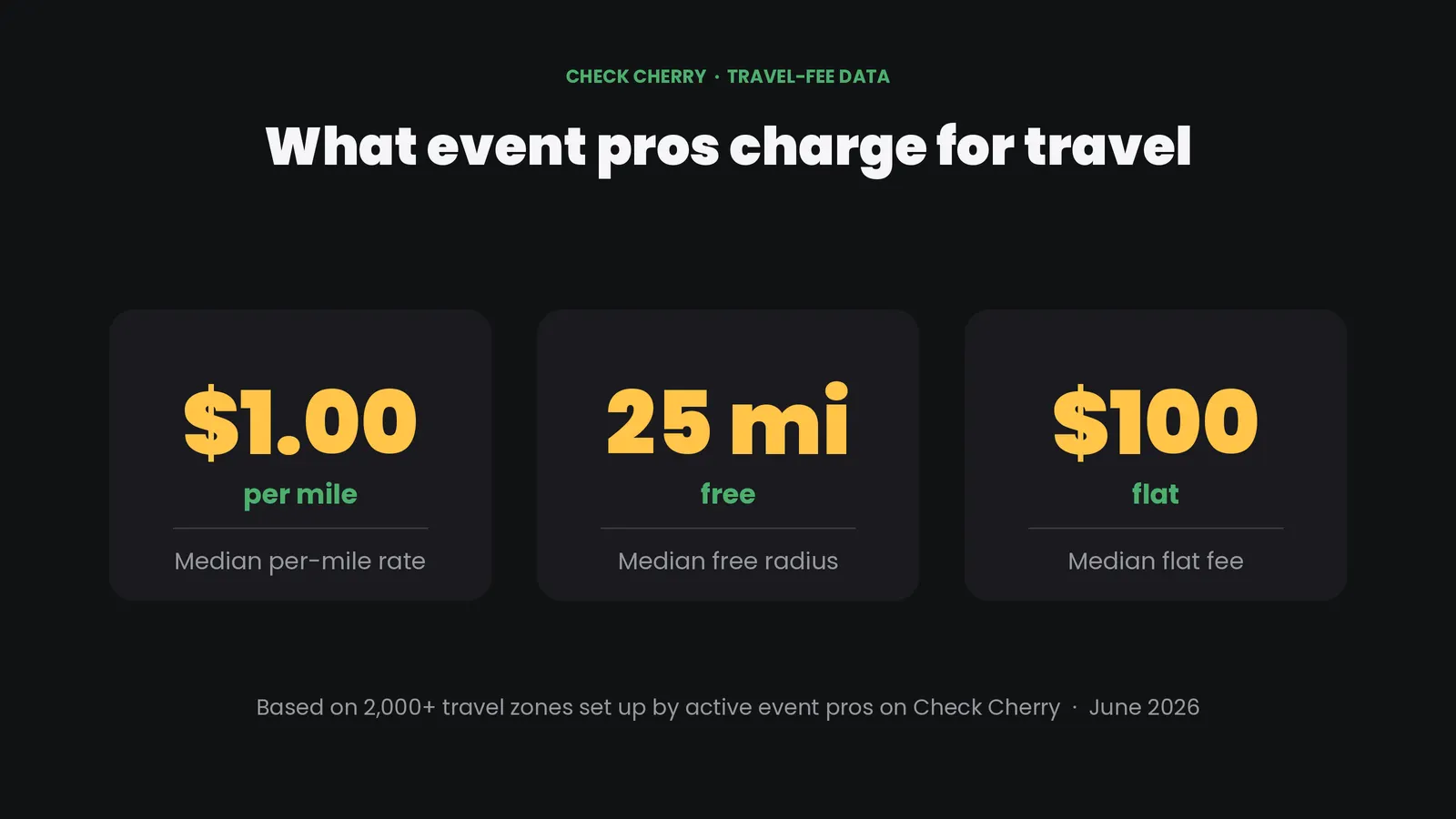
We pulled the travel-fee settings from more than 2,000 travel zones set up by event pros currently active on Check Cherry. Line them all up and a clear market rate appears. These are the medians, the middle of the pack, not an average dragged around by a few outliers.
- Per-mile rate: $1.00 a mile. Most operators land between $0.75 and $2.00.
- Free travel radius: 25 miles. The typical distance pros will drive before the meter starts.
- Flat travel fee: $100. For those who charge one flat number, the middle sits between $50 and $175.
How much should you charge per mile?
That $1.00 median is your anchor. Where you land inside the typical range is mostly about what you haul. A solo operator in a fuel-efficient car can sit at the low end. If you are towing a trailer, a booth, or a full bar setup, you belong toward the top.
How big should your free travel radius be?
Most pros bake a free travel range into every package, then start charging past it. The median free radius is 25 miles. Here is why that number is not arbitrary: the typical booking sits about 24 miles from the operator base, right at the edge of that free zone. In other words, the most common free radius is calibrated almost exactly to where the average job actually is. A 25-mile free zone covers the bulk of local work without a single line item, keeps your quotes clean for the clients closest to home, and lets the per-mile fee kick in for the longer drives that genuinely cost you.
What about a flat travel fee?
Some operators skip the per-mile math and charge one flat number, sometimes in tiers (free to 25 miles, a set fee to 50, a bigger fee beyond that). Among those who do, the median flat fee is $100, with most landing between $50 and $175. Flat fees are simpler to quote, and they let you make a far zone meaningfully more expensive than a near one. They are less precise than per-mile, which is why per-mile is the more common setup: about two-thirds of active event pros (67%) charge by the mile, while roughly one in six use a flat fee.
What different event pros charge
Travel pricing is not one-size-fits-all. A wedding DJ books regionally and thinks nothing of a long drive. A photo booth operator runs tighter and more local. The numbers below come from the verticals with enough currently active businesses to report a reliable median.
| Vertical | Free radius | Per mile | Flat fee |
|---|---|---|---|
| Photo booth | 25 miles | $1.00 | $85 |
| Wedding DJ | 50 miles | $1.50 | $200 |
| Other event services | 25 miles | $1.25 | $99 |
The pattern is worth reading. Wedding DJs offer the widest free radius (50 miles) and the highest flat fee ($200), because weddings pull them well outside their home city. Photo booth operators run tighter, a 25-mile free zone, while anchoring the most common per-mile rate at $1.00. The same math applies if you run an off-site catering or mobile bar business: staff, equipment, and product ride along, so every mile has a real cost.
One-way or round-trip?
This is where the old advice gets it wrong. The conventional wisdom says most pros bill one-way, charging on the distance out to the venue. The data says the opposite. On Check Cherry, about two-thirds of active event pros who charge per mile (64%) bill for the round trip. Only about a third charge one-way.
Both approaches can be fair. They just need different per-mile rates to land in the same place.
- Round-trip is the more honest picture of your real cost, since you have to drive home too. It also makes your per-mile number look lower, which can help during the sale.
- One-way is easier for a client to follow, because most people will not think to double the distance. If you go one-way, set a higher per-mile rate so the trip home is still covered.
Why charge a travel fee at all?
If you sell packages, you have probably folded a little travel into your base price already. That works until a client asks you to drive 62 miles, and suddenly the booking is barely profitable. A travel fee fixes that without forcing you to raise prices on everyone.
Plenty of pros skip it: nearly 4 in 10 active event businesses on Check Cherry (38%) do not charge a travel fee at all. For some that is a deliberate choice to keep quoting simple. But if you regularly drive past your free zone, charging nothing for travel usually just means quietly eating the cost.
What if you offer online booking?
Online booking changes the question entirely. Instead of working a travel fee into a quote by hand, Check Cherry's travel fee software measures the distance from your home base to the venue, applies your free radius, and folds the right fee into the price the client sees before they book. There is no quote to pad and no flinch to brace for, because travel is just part of the transparent total.
It also answers the quiet fear that a travel fee will scare people off. On Check Cherry, roughly two out of three confirmed bookings that run through a travel zone include a travel fee. Seeing the number up front does not stop people from booking.
It also widens your map. A travel fee is permission to say yes to the job two towns over, because the extra drive now pays for itself instead of quietly eating your margin.
How to figure out your own per-mile rate
The market median is a starting point, not a law. If you want to build your rate from the ground up, three costs drive it.
Travel time
Your time is usually the biggest line. A 40-mile drive each way can add two hours to a job. If you send staff, pay them for that drive time, or you will struggle to keep good people willing to work the far bookings.
Fuel
Run a rough number for your own vehicle. Divide your cost per gallon by your real-world miles per gallon, fully loaded with gear, and you have your fuel cost per mile. It is usually the smallest of the three costs, but it is the one clients understand instantly.
Vehicle wear and tear
Every mile you drive ages the vehicle through depreciation, maintenance, insurance, and repairs. Estimates range from about $0.21 to more than $0.62 per mile depending on the vehicle. The Edmunds True Cost to Own calculator will give you a figure for your exact make and model.
A worked example
Put those three costs together for a typical job and you get a real number to compare against the market. Here is one operator's math for a 40-mile drive, staffed at $20 an hour, in a vehicle that gets 21 miles per gallon on $4.33 fuel.
| Cost factor | Per mile |
|---|---|
| Fuel | $0.21 |
| Wear and tear | $0.66 |
| Staff time | $0.52 |
| True cost | $1.38 |
That $1.38 is the interesting part. The real platform median, $1.00 a mile, lands just below it. In other words, the rates working operators actually charge sit right around what travel genuinely costs. The market has quietly priced this correctly, which is a good sign your own number should live in the same neighborhood.
Should you just use the IRS mileage rate?
Each year the IRS publishes a standard mileage rate. It is built for tax deductions, not for billing clients, so it is usually a poor pricing tool. It tends to sit below what travel really costs a working event business, and it ignores your time entirely.
It still matters for your taxes, though. Whether or not you charge travel fees, you can generally deduct the standard rate for business miles you drive. Track your mileage and talk to your accountant about doing it right.
Let Check Cherry do the math
Setting a rate is one thing. Calculating it correctly on every quote is another. With built-in travel fees, Check Cherry measures the distance, applies your free radius, and adds the fee automatically when a client books. You can build multiple travel zones, set a per-mile or flat rate, and even block bookings that fall outside the area you are willing to serve.
Stop guessing on travel
Set your free radius and per-mile rate once, and let Check Cherry add the right travel fee to every booking automatically.
Start free trial